
From Conventional to Organic: 300 Hectares of Almond Trees Changing Course
When Change Begins with a Decision in the Field
Agriculture changes when the decisions made in the field change. And few decisions are as significant as transitioning from conventional to organic management on a large-scale farm.
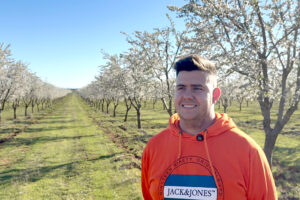
This is the case of Jesús Peñarrubia, a farmer from Ledaña (Cuenca), who manages a 300-hectare almond farm and shares his experience in this transition process with Agrosemillas.
His testimony reflects an increasingly prevalent reality in the sector: the need to produce with more sustainable criteria, without losing sight of the economic viability of the operation.
The Challenge: Producing Sustainably Without Compromising Profitability
Transitioning to organic is not just about changing inputs. It means rethinking the entire farm management: soil nutrition, weed control, cover crop management, and the relationship between all these factors.
On a 300-hectare farm, every decision is magnified. What works on a small plot doesn’t always scale well. And what seems viable in theory must be proven in the field, season after season.
Therefore, the transition to organic requires tools that provide real value without adding complexity or risk.
Green Series as an Ally in the Transition
Along this path, Green Series has become a useful tool for farms like Jesús’. Its ability to provide soil cover and agronomic value without generating significant competition with the crop aligns with the real needs of a farm in transition.
It’s not just about covering the soil. It’s about ensuring that cover works for the system, not against it.
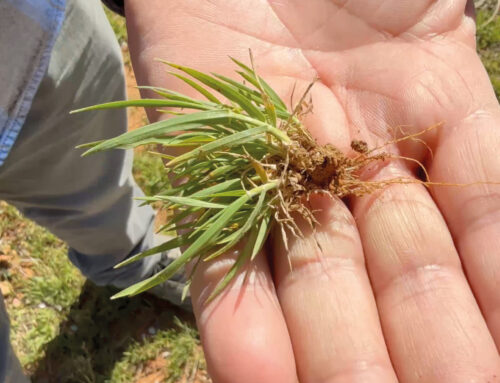
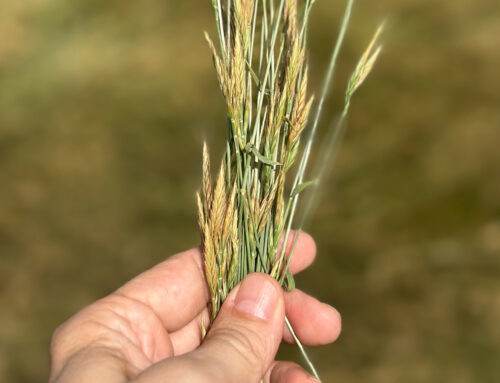
In organic almond management, a cover crop that competes for water and nutrients can become more of a problem than a solution. Green Series, developed from Brachypodium—an indigenous species of the Mediterranean environment—offers contained growth that allows it to coexist with the crop without hindering its development.
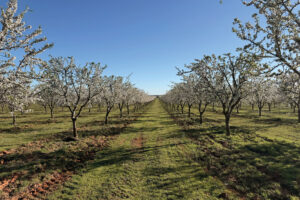
What Green Series Offers on an Organic Almond Farm
The value of Green Series in this context is not in what it grows, but in what it solves. On a large-scale organic farm, the cover crop must fulfill several functions without creating dependencies or additional costs.
With Green Series, farmers can expect:
- Effective soil protection against erosion
- Progressive improvement of soil structure and life
- Natural control of broadleaf weeds, reducing the need for intervention
- Less competition for water and nutrients with the almond trees
- Simpler management, with fewer mowings and lower operating costs
All this translates into a more balanced, resilient farm that is more aligned with the criteria required for organic production.
An Increasingly Present Reality in the Sector
Jesús Peñarrubia’s case is not isolated. More and more farmers of woody crops—almonds, olives, pistachios, vineyards—are considering the transition to more sustainable production models. And in this process, the tools they choose make the difference between a viable transition and one that becomes complicated.
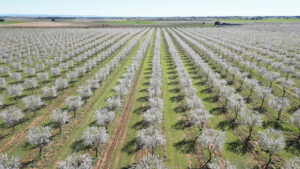
Sustainability is not a destination. It is a process built decision by decision.
Green Series: Cover, Protect, and Support
Green Series is not just another cover crop. It is a proposal designed to support the crop, not to compete with it. And on farms undergoing organic transition, this difference becomes a strategic advantage.
Because when farmers decide to change course, they need solutions that support them along the way, not ones that add uncertainty.
Because in organic farming, the best cover is not the one that grows the most. It’s the one that integrates best.
Trust, Cultivate, Grow.



Leave A Comment